
Case Study
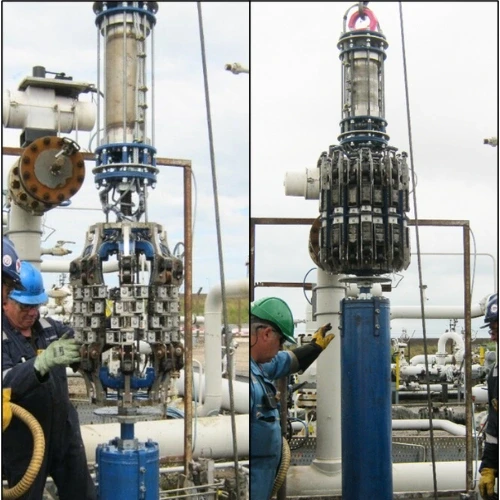
Vertical casing inspection
Pipeline Description:
Inspection of 200 m long casings of 12’’ and 20” diameter in an LPG cavern. The cavern is mined into rock that is virtually a solid amorphous mass and is at a depth of almost twice that required to balance the pressure of propane. The static head of the ground water (water table) is greater than that exerted by the stored product thereby preventing outward movement of LPG into the rock. The casings to be inspected have standard wall thickness without any inner diameter changes due to installations or different wall thicknesses and without any noteworthy inclination.
Why is it challenging?
Vertical Casing inspection is an interesting application as the tools, which are normally applied in horizontal pipelines, must be customized to carry out the inspection vertically. Several challenges are presented. Since the tools are fed into the casing by gravity, they must allow for the friction of passing through the pipe at the same time presenting the inspection sensor arrays as close as possible to the pipe wall. Transition from air/gas phase into water meant that buoyancy was also be considered.
Target of the inspection:
In common with pipeline inspection, the objective in casing inspection is to achieve a high-resolution data set about metal loss and girth welds to confirm casing integrity. Minimizing costs since neither workover nor logging units are required.
Request Download
Enter your contact information and we will send you the requested file soon.