
Case Study
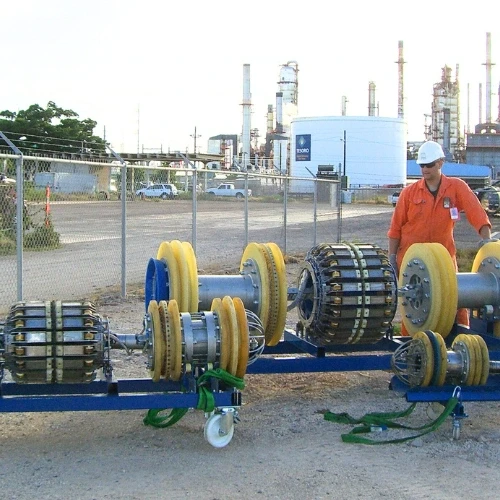
BIDI inspection of tanker terminal
Pipeline Description:
Three pipelines connect a refinery tank farm on the island of Oahu (Hawaii) with a common pipeline end manifold (PLEM) on the seabed at a water depth of 30 m (~100 ft). The PLEM is connected with flexible hoses to the single point mooring (SPM) at the surface from where the connection to tankers is made. The pipelines serve for import of crude oil (30”) as well as export of products (16” and 20”). They extend over 1.6 km (~1mls) over land and 2.8 km (~1.8 mls) into the sea to the PLEM. This tanker loading/unloading system has never been inspected before.
Why is it challenging?
There are no possibilities to install pig traps at the PLEM on the seabed to perform a “standard” inspection from trap to trap using conventional uni-directional ILI tools. Further, the pipelines have several 1.5D/90° bends and bend combinations on the land section, passing under roads and ditches when passing through a densely developed industrial environment.
Target of the inspection:
Determine the presence of internal and external metal loss, geometric anomalies and other features that may affect the pipeline integrity.
Request Download
Enter your contact information and we will send you the requested file soon.