
Case Study
DMR inspection through cement liner
Pipeline Description:
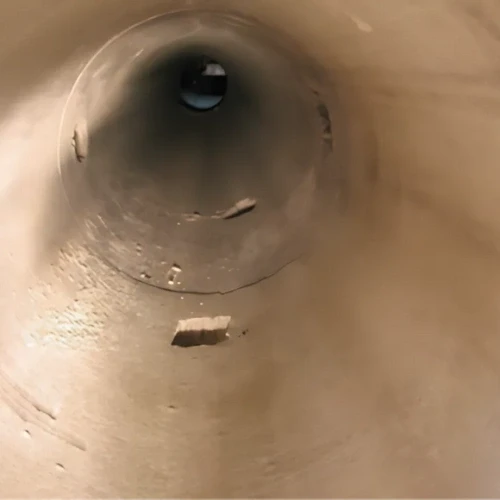
8” to 14” brine pipelines, Northern Germany, carbon steel pipelines with standard wall thickness (6.3 to 11.0mm). To protect from the corrosive product (saturated NaCl brine), internal cement lining is applied, approx. 4 to 10mm thick. It is known that the cement layer occasionally breaks off the internal pipe wall, where the steel surface becomes exposed to the product. Further, cracks may occur in the cement with the same result and potential corrosion underneath the liner.
Why is it challenging?
An MFL inspection is not feasible since the magnetic field cannot be applied through the cement sufficiently and the sensors cannot get close enough to the pipe wall. UT is prohibited as the sound waves are diffused inside the cement.
Target of the inspection:
Determine presence and thickness of the cement liner over length and circumference of the pipeline. Further, identify internal metal loss at spots where the cement is lost and underneath the cement coating.
Download anfordern
Geben Sie Ihre Kontaktdaten ein und wir senden Ihnen die angeforderte Datei zu.